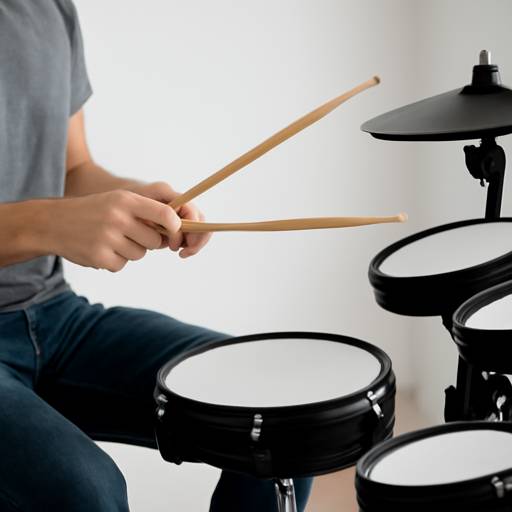
Stop Guessing and Start Grooving: Online Drumming Lessons That Actually Move the Needle
JerryMCordell,
Why Online Drumming Lessons Work in the Real World
There’s never been more content for drummers—yet many players still feel stuck. The problem isn’t motivation; it’s structure. Scrolling through random tutorials can leave you with flashy licks but no reliable time, no dynamic control, and no plan. That’s where online drumming lessons shine. A focused, progressive path—paired with clear assignments and feedback—turns scattered practice into measurable growth. Whether you’re shedding on a practice pad in a studio apartment, balancing rehearsals with a day job, or prepping for your first jazz combo, a well-built online approach bridges the gap between where you are and how you want to sound.
Unlike a one-off video, a guided online lesson sequence builds skills in layers: sound first, motion second, notation third. You’ll internalize essential mechanics—grip, stroke types, foot technique—alongside musical skills like time feel, phrasing, and listening. A reliable online program also works in your real-life setting. You can film from a phone, slow the footage, and rewatch corrections at your pace. Missed a nuance in a buzz roll, a feathered bass drum detail, or a brush turn-around? Replay it. Need to calibrate hi-hat splash timing or heel-toe doubles? You’ve got it on demand.
Accountability is the hidden superpower. You’ll submit short videos—60 to 120 seconds is ideal—on specific tasks: accents and rebounds at set tempos, swing ride consistency with quarter-note pulse, or a two-minute funk groove with ghost-note control. Your instructor responds with precise adjustments, not vague generalities. That tight feedback loop builds confidence quickly. And because online tools capture your playing, you accumulate a library of progress clips—proof that the hours you’re putting in are paying off.
Real-world application matters most. Strong time and clear articulation make you valuable in any setting: rock covers, small-group jazz, pit orchestra, songwriter sessions, or church services. A solid online curriculum includes play-alongs, chart-reading, and transcription-based learning so the “classroom” transfers to rehearsal and the stage. If you want a thoughtful, musician-first approach grounded in groove, feel, and practicality, explore online drumming lessons that emphasize real musical outcomes over internet flash.
A Practical Roadmap: From First Strokes to Gig-Ready Drummer
Great drumming starts with a simple equation: sound + time + touch. Your roadmap should reflect that clarity, guiding you through a sequence that builds musical fluency, not just chops. For newer players, begin with mechanics and motion. Establish a comfortable grip, a relaxed fulcrum, and a consistent rebound stroke. Practice singles, doubles, and paradiddles with accents at slow tempos, listening for tone. Prioritize foot fundamentals—heel-down and heel-up—on the bass drum; add a controlled “chick” on the hi-hat. Bring those motions into music with classic rock beats, quarter-note ride patterns, and simple fills that resolve on the 1. Reading basics follow naturally: eighth notes, rests, ties, and simple charts so you can decode grooves from the page to the kit.
Intermediate steps focus on coordination and vocabulary. You’ll map common independence patterns—straight-eighth rock, 16th-note funk with ghost notes, and swing ride with comping. Develop a consistent ride cymbal with an integrated hi-hat (on 2 and 4) while the snare comps conversationally. Layer in bossa and samba ostinatos to learn motion economy and touch. Introduce flams, drags, and 16th-note permutations for practical fill construction. Reading evolves into kicks-over-time charts and sectional roadmaps (intro, verse, pre-chorus, chorus, bridge) so you can support songs and ensemble hits with confidence. Throughout, you’ll cultivate dynamic control—pp to ff—because volume, tone, and blend are what bandleaders hire.
Advanced work sharpens artistry: brush technique, odd meters (5, 7), polyrhythms (three over two, two over three), and tempo control that’s unshakeable. You’ll refine ride cymbal beat placement, explore linear phrases that breathe, and internalize clave-informed grooves for Afro-Cuban and Brazilian feels. Transcribing short phrases from masters anchors your style in musical language, not abstract patterns. You’ll also learn to self-produce: record clean drum audio, align to a click without sounding robotic, and shape your tuning and touch per genre.
How do you practice all this without burning out? Use a compact, repeatable routine. In 45 minutes: 10 minutes of rudiments with accents and sound focus, 10 minutes of coordination or reading, 15 minutes on repertoire (a chart, a play-along, or a transcription), and 10 minutes of creative application—improvise fills or orchestrate the day’s material around the kit. Track tempos, note trouble spots, and set micro-goals for the next session. A consistent, musical routine beats marathon, random sessions every time.
Tools, Feedback, and Real-World Examples: How Remote Coaching Elevates Your Playing
Modern tools make remote learning precise and musical. Start with a simple setup: a phone for video, a metronome app, and headphones. Add a second angle later to show feet. For audio, even a low-cost interface with overhead mics lifts clarity so your instructor can hear ghost notes, cymbal blend, and bass drum definition. Slow-downer and looping apps help you dissect transcriptions and difficult fills. A note-taking app or paper journal ties it together with a to-do list, target tempos, and reflections on feel—did the ride pattern drift? Did the backbeat collapse on the fill? That awareness is where breakthroughs happen.
Effective online instruction delivers targeted feedback. A strong coach doesn’t bury you in theory—they give you one or two adjustments that change your sound: drop the wrist angle to open the rebound, pull the hi-hat stroke closer to the edge for a lighter “chick,” lift the tip of the ride to let the cymbal breathe, or move the snare accent from the rim to the center for more authority. They’ll mark your videos with timestamps and send a quick clip demonstrating the corrected motion. The next week, you submit a tighter take and move on. That cycle—play, review, correct—compresses months of guesswork into measurable weekly gains.
Consider a few scenarios. A 42-year-old guitarist turned drummer wanted to hold down a wedding setlist. Over four months of structured online drumming lessons: a daily 20-minute routine built time and stamina; chart-reading drills with kicks-over-time simplified complicated hits; play-alongs refined transitions and fills that land squarely. He played his first gig without train-wrecks—and earned a call back. A college jazz student stuck with “busy” comping trimmed the ride pattern, integrated hi-hat on 2 and 4, and practiced short, phrase-based comping cells—one chorus of clarity replaced three choruses of clutter. A rock drummer with heavy hands learned to play quietly with authority using thinner sticks, touch-based doubles, and low-volume cymbals—now they can rehearse in an apartment without sacrificing feel.
Remote study also solves practical barriers. Live in a small town with no local drum teacher? You can still get world-class coaching. Tour schedule all over the map? Asynchronous video submissions keep you progressing. Practice on an electronic kit at night? Your instructor evaluates time feel, consistency, and dynamics through MIDI velocity and audio nuance. The big picture is simple: with the right guidance, tools, and routine, you develop the fundamentals that make drummers hireable—solid time, great touch, musical decisions—and you do it in a way that fits real life. That’s the promise of modern, online drumming lessons done right: not just chops, but music.
Licences, sécurité et équité : les fondations indispensables d’un meilleur casino en ligne Avant de comparer les bonus ou l’esthétique, la première brique qui distingue un casino en ligne de qualité, c’est sa conformité. Un meilleur site affiche clairement sa licence (Malta Gaming Authority, UK Gambling Commission, Curaçao eGaming, entre…